Working Principle of Industrial High‑Speed Interlock / Coverstitch Machine
Industrial high‑speed interlock machines (also widely called coverstitch machines) are core equipment in modern garment manufacturing. They are designed for high‑efficiency, high‑elasticity stitching of knitted fabrics, stretchwear, underwear, sportswear, and bottom hemming. Unlike lockstitch machines, they use a multi‑needle, multi‑looper chain‑stitch system without a bobbin, enabling stable high‑speed operation up to 4,000–5,500 stitches per minute.
Core Structural Components
The machine's performance relies on precise coordination of five key systems:
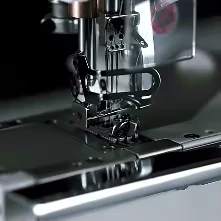
Needle SystemDual or triple needles penetrate the fabric from top to bottom, carrying needle threads to form the surface straight stitches.
Looper SystemOne or two high‑precision loopers catch and interlock needle threads from below, forming the chain loops that give stitches elasticity.
Differential Feed MechanismIndependent front and rear feed dogs with adjustable feed ratios prevent stretching, gathering, or waviness on thin or elastic fabrics.
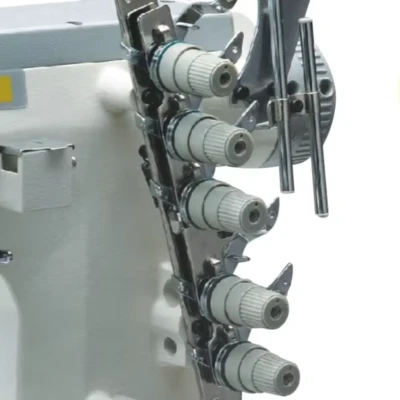
Thread Take‑up & Tension ControlSeparate tension disks and take‑up levers regulate each thread path to ensure balanced, smooth loops at high speed.
Direct‑Drive Servo MotorIntegrated high‑torque motor provides instant start/stop response, low noise, low vibration, and stable high‑speed running.
Stitch Formation Principle (Step‑by‑Step)
Interlock stitches belong to the 400‑/600‑series chain stitches and form in four synchronized steps:
Needle PenetrationNeedles descend, carrying threads through the fabric to the lower looper area.
Looper HookingLoopers move horizontally to catch needle thread loops and expand them.
Thread InterloopingAs needles rise, loopers shuttle threads to create interlocked chain structures.
Fabric Feeding & TighteningTake‑up levers tighten loops; differential feed dogs advance fabric one stitch length; the cycle repeats continuously.
The result is a double‑sided finished stitch: parallel straight lines on the top and elastic thread chains on the bottom.
Key Mechanical Principles for High‑Speed Stability
No Bobbin DesignEliminates bobbin replacement and rotational inertia, supporting ultra‑high‑speed continuous sewing.
Full SynchronizationNeedles, loopers, feed dogs, and take‑up move in strict electronic‑mechanical sync to avoid skipped stitches or thread breakage.
Active Thread ControlMany models use controlled thread delivery to maintain consistent loop length and elasticity across thin to heavy fabrics.
Low‑Inertia Moving PartsLightweight, high‑rigidity components reduce vibration and noise during long production runs.
Typical Applications
Bottom hemming for T‑shirts, polo shirts, and sweatshirts
Seaming and topstitching for leggings, sportswear, and swimwear
Decorative cover stitches and flatlock seams
Joining rib cuffs, collars, and waistbands
Conclusion
The industrial high‑speed interlock machine achieves high efficiency and quality through bobbin‑free multi‑looper interlooping, differential feeding, and full synchronous transmission. It is the essential machine for creating professional, elastic, flat seams on modern stretch and knitted garments.